'Great Spirits have always encountered violent opposition from mediocre minds' - Albert Einstein
1 For the kingdom of the heavens is like a man, a householder,
who went out [of a previous true religion - the Pre law church of the to hire saints into the under law]
early [in the morning] to hire workers
for his vineyard.
2
When he had agreed with the workers [to be paid]
out of [ek]
a denarius
[genitive], [for] the day, he sent them forth into his vineyard.
3
Going out also [of a previous true religion] about the 3rd hour, he saw others standing [Christian Proselyte Call into the , rather than Jewish
call, since they were standing at the altar i.e. priests] unemployed in the marketplace,
4
and to those he said, 'You also, go into the vineyard, and whatever is just I will give you [when you are spirit sanctified then what is just is an angelic resurrection].'
5
So off they went. Again he went out [of a previous true religion] about the 6th and the 9th hour
and did likewise.
6
But,
about the 11th [hour] he went out [of a previous true religion] and found others standing [with a water baptism, i.e. Proselytes], and he said to them,
'Why have you been standing here all day
unemployed?'
7
They said to him, 'Because nobody has hired us.' He said to them, 'You too go into the vineyard.'
8
When it became late, the Lord of the vineyard
said to his
foreman, 'Call the workers
and pay them their wages, proceeding from the last to the first.'
9
When the 11th hour
[ones] came, they each received a denarius.
10
So,
when the first came, they concluded they would receive more; but they also each received a denarius.
11
On receiving it they began to murmur against [kata]
the householder [genitive from kata]
12
and said, 'These last [ones] did one hour, still you made them equal to us who bore the burden
of the day and the burning heat!'
13
But in reply to one of them he said, 'Fellow, I do you no wrong. You agreed with me [wages]
[Greek thinks it is cool to leave 'obvious' words out]
of a
denarius, did you not?
14
Take what is yours and go. I want to give to this last [one] the same as to you.
15
Is it not lawful for me to do what I want with my own [things]? Or is your eye
wicked because I am good?'
16
In-this-way the last [ones] will be first, and the first [ones]
last (Matthew 20).
The Gentiles were called last into the in the first presence and so a re called in the 2nd presence. The Jews were called 1st in the first presence into the and so arrive last in the 2nd presence into the ..
Account starts Matthew 19:23 and ends Matthew 20:16. This is the only symbolic part.
Symbolic : (4,4,2,1,1,1,1,4,2,1,1,3,1,0,1,0) = 27 (3 threads).
Symbolic : Man, Householder, Workers, Vineyard, Denarius, Day, Hour, Marketplace, Lord of Vineyard, Foreman, Wages, Burden of Day, Heat, Fellow, Eye = 15
Denarius (3), Hour (4), Day (2) Workers (3), Householder (2).
Multiple Designations: Man, Householder, Lord of Vineyard.
Let us start with the event symbolism of this parable. The obvious first reaction is to relate the Proselyte call made at Pentecost during the 3rd hour of the day and the Samaritan call made during the 6th hour of the day and the Gentile Call to Cornelius made during the 9th hour of the day to the calls made at the same hours in this account. This is correct for the event symbolism.
| Day | Time period of the First Christian church from 33Nisan16, its appointment to rule to 84Nisan14 its fall |
| Man, Householder, The Master of the Vineyard | |
| Standing | In the |
| Marketplace | The Temple. Attending the congregation meetings |
| Vineyard | |
| Unemployed | Not baptised in water |
| Hired | Water baptised |
| Denarius | Citizenship of the on earth |
| Evening | |
| Whatever is just | Angelic life in heaven, since these one are born again as angels! |
| First call for a denarius a day | Jewish call into the new covenant (the ), when the water of the was turned into the wine of the at Can on 29Heshvan29 |
| Second call at 3rd hour | Proselyte call into the new covenant made on 33Sivan5, Pentecost (at the 3rd hour of the day). |
| Third call at 6th hour | Samaritan call to be sanctified into the new covenant, 34Shebat10 (made at the 6th hour of the day). |
| Fourth call at 9th hour | Gentile call to be sanctified into the new covenant, 36Tishri14 (made at the 9th hour of the day) |
| Fifth call at 11th hour | Gad: Jewish call to s 36Tishri15-27 to 66Tishri15-27, 30 years, in |
| Burning Heat | Physical Jews who became Christians were persecuted by the Physical Jews who did not. A persecution due to jealousy. |
15 These [people] are, in fact, not drunk, as you suppose, for it is the 3rd hour of the day (Acts 2).
6 In fact, 's fountain was there. Now , tired out from the journey,
was sitting at the fountain just as he was. The hour was about the 6th.
7 A woman of Samaria came to draw water. said to her: Give me a drink (John 4).
3 Just about the 9th hour of the day he saw plainly in a vision an angel of God come in to him and say to him: Cornelius! (Acts 10)
30 Accordingly Cornelius said: Four days ago counting from this hour I was praying in my house at the 9th hour, when, look! a man in bright raiment stood before me (Acts 10).
The 11th hour guys are paid before the 1st hour guys because the resurrection into the as humans works in reverse order. The first ones (plural), who complain get a response to only one of them from the householder:
13 Fellow I do you no wrong. You agreed with me for a Denarius, did you not ? (Matthew 20)
This Yes/No question means that at least one of the first ones did not agree this, in the word symbolic meaning. Compare these two scriptures:
1 For the kingdom of the heavens is like a man, a householder, who went out early in the morning to hire workers for his vineyard.
33 Hear another illustration: There was a man, a householder, who planted a vineyard and put a fence around it and dug a winepress in it and erected a tower, and let it out to cultivators, and travelled abroad (Matthew 21). (The story involves two fathers and two sons - ed)
The Successive Designations Principle tells us that the account splits into two word symbolic accounts. One for the designation 'man' and the other for the designation 'householder'. Now the word 'man' distinguishes one fulfilment from the other, so one fulfilment does not involve men, so it involves angels. So the two word symbolisms, are one for men and the other for angels (born again men).
| A man | , the father of the water baptised congregation |
| Master of the vineyard | |
| Man in charge | Methuselah |
| Denarius | Priesthood in the |
| Vineyard | True congregation |
| Marketplace | The temple, attending the congregation |
| Unemployed | Unbaptised in water |
| Standing | Ready for water baptism (repentant) |
| First call | into Moses through the sea & cloud & law |
| About 3rd hour call | John the Baptist - 1 - |
| About 6th hour call | - 2 - |
| About 9th hour call | Russell - 3 - |
| About 11th hour call | Ritchie - 4 - |
| Day | ’s day from 1943 BC to 2008 AD |
| Evening |
was impaled at the third hour, then a darkness fell at the 6th hour and he died at the 9th hour, when the darkness ended and memorial tombs were opened. So the darkness in this symbolism is between to , which is Christendom, the Christian Babylon period. Moses was sanctified and so was the line to (both sides - Mother and Father).
The big picture is:
9 answered: There are twelve hours of daylight, are there not? If anyone walks in daylight he does not bump against anything, because he sees the light of this world.
10But if anyone walks in the night, he bumps against something, because the light is not in him (John 11)
So what happened on the 1st 2nd 4th 5th 7th 8th 10th and 12th hours of the day? A man who sees the light of this world (who is Christ) and who walks, is sanctified. 12 hours, 12 tribes, 12 gates, 12 apostles, 12 sons of , 12 pearls, 12 foundation stones. These are 12 calls to be sanctified. Each hour is a call. The householder is The Aaronic priesthood and then , , , . The first ones, who received a Denarius, complain:
12These last put in one hour’s work, still you made them equal to us who bore the burden of the day and the burning heat (Matthew 20)
The expression: '11th hour solution' is used everywhere today, meaning a last minute solution, and it stems from this parable.
But the 11th hour is not the last minute, because the 11th hour is not the last hour of a 12 hour day, the 12th hour has this position in a 12 hour day. Understanding this is a key to understanding this parable. The eleventh hour workers worked two hours, the 11th and the 12th. They worked from 4 pm until 6 pm. 'The last ones' were therefore not the 11th hour workers but the 12th hour workers who bore the burning heat of Armageddon, and the burden of the day of (the great and fear inspiring one) being the great crowd. In the parable, the first hour guys bear the day and heat because they work all day in the heat. So in the symbolism, their travails are ‘made equal’. Here it is:
| Day | 6,000 year 'day' of 's lease on Adam from 3993Nisan14 to 2008Nisan14 |
| A Householder | God, the father of the spirit baptised congregation, the Householder of the 3 worshipping arrangements of the Jews, and of , , , - His vineyard |
| Late | from 2008Nisan22 to 3008 |
| Denarius | Administrative authority in the on earth as a human, the Sabbath resting of the Lord. |
| Hour | A call into a spirit covenant |
| Vineyard | Testing workplace for the saints |
| Workers | Saints |
| Standing | Water baptised. |
| Unemployed | Unsanctified (unbaptised in spirit) |
| Marketplace | Attending the congregation meetings |
| Master (of the vineyard) | the head of the congregation |
| Man in charge | Methuselah in |
| 1st hour workers | Into the before the (under law) |
| 2nd hour workers | Reuben, the Jewish call into the () under |
| Householder goes out of the vineyard | 33Nisan14, the end of the . |
| 3rd hour workers | Simeon, the Proselyte call into the () under |
| Not counted hour workers | Levi, the Samaritan call into the () under |
| 4th hour workers | Judah, the Gentile call into the () under |
| 5th hour workers | Gad, the Jewish call into the under |
| Householder goes out of the vineyard | The end of , the fall of the Roman Catholic Church. |
| 6th hour workers | Dan, the Jewish call into the () under |
| 7th hour workers | Naphtali, the Gentile call into the () under |
| 8th hour workers | Asher, the Proselyte call into the () under |
| Householder goes out of the vineyard | The end of , the fall of the Gnostic Church. |
| 9th hour workers | Issachar, the Samaritan call into the () under |
| 10th hour workers | Zebulun, the Gentile call into the () under |
| Householder goes out of the vineyard | The end of , the fall of the Watchtower (around the 11th hour - ambiguous as to whether before during or after the 11th hour) |
| 11th hour guys standing unemployed | Manasseh, proselyte call into the () under |
| 12th hour workers | Ephraim, Gentile call into the () under |
Householder (2x), Denarius (3x), Hour (4x), Vineyard (5x), Workers (3x), Marketplace (1x), Master of the vineyard (1x).
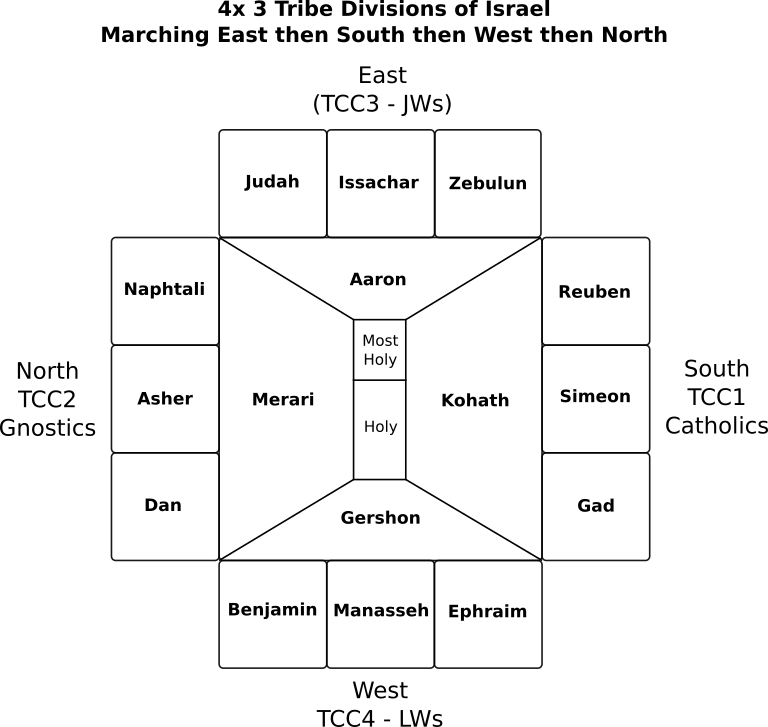
These have to match the 4x 3 tribe divisions of Numbers2 - see U151#7 and the stones on Aaron's ephod of Exodus28
The householder goes out of the old religion (pre law) and hires for the new religion the law, the house of Aaron and Moses, which ended on 33Nisan14:
| 1st hour workers | Those sanctified with the inferior wine of Cana, into the , sanctified before Peter was called, before the first miracle at Cana, washed in but not into the new covenant. |
| 2nd hour workers | Reuben: Jewish call under house of Moses, Aaron and the Law in 29Heshvan29, 30x after was circumcised on 2Heshvan29 BC, on the 8th day after his birth on 2Heshvan21 BC the 2:1 temple ratio prophecy. 29Heshvan29 was the 7th day of the marriage feast of Cana. Peter is sanctified on 29Heshvan29. The call lasts for 30 years to 59Heshvan29. |
The householder goes out of the old religion (the law which ended on 33Nisan14) and hires for the new religion , the House of (appointed 33Nisan16 over all saints, it was appointed to feed them on 29Tishri10)
| 3rd hour workers | Simeon: The 30 year Proselyte call from 33Sivan5 to 66Sivan5. A call to the house of Aaron, to proselytes of Moses to join the . First responders were baptised on 33Sivan5. |
| Not counted | Levi: The Samaritan call . But it is unregistered so it does not produced children to . Instead Levi falls out of the and into the and the . For those who failed to bring enough oil to become kings say: Lord, Lord, open to us. A scriptural command which did not refuse and therefore must be carried out. So Levi becomes s and s from 34Shebat10 to sometime on or before 2020Tishri10 for s, the end of their entrance into Reverted Laodicea and to sometime on of before 2025Sivan16 for s, the end of the 1600 stadia of Revelation14 - see U151#14. |
| 4th hour workers | Judah: Gentile call 36Tishri14 (the last harvest day of the year), first made under to 66Tishri14, 30 years, in (truncated from 100 years to 30 years because fell on 84Nisan14). Then it runs for for another 70 years in making 100 years of the Roman Centurion Cornelius |
| 5th hour workers | Gad: Jewish call to s 36Tishri15-27 to 66Tishri15-27. 30 years, into : It might have had a 30 year continuation call into the part of to give them 30,60,100 as well as 30+60+100.as in the parable of the sower - see U63. This would run from 173Sivan15 to 203Sivan15. These dates are the first possible after appeared to on the road to Damascus - see U42. |
9 When came to see that she had left off giving birth, she proceeded to take her maidservant and to give her to as wife. (Genesis 30 )
The householder goes out of the old religion (, which became the Roman Catholic Church. It fell on 84Nisan14) and hires for the new religion , the House of , the Gnostics (appointed 66Nisan22, to feed the s and on 66Heshvan2 to feed the s)
| 6th hour workers | Dan: 100 year Jewish call 66Chislev29, to sons of independent of worship house, to enter the until 166Chislev29 |
| 7th hour workers | Naphtali: 60 year Gentile call from 73Iyyar14 to 133Iyyar14, under , to enter the . |
| 8th hour workers | Asher: 30+60+100=190 year Proselyte call from 173Sivan7 to 363Sivan7, under the 2nd administration of (that of , the rather than , the ) to those in the congregation of to be sanctified into |
33 So Laban went on into the tent of and into the tent of and into the tent of the 2 slave girls, but did not find them. Finally he went out of 's tent and went on into 's tent. (Genesis 31 )
The law then then ( and ) then then .
Before is appointed and after has become a false church
The 4 physical first presence calls into the were the Jewish, the Proselyte, the Samaritan and the Gentile Calls.
The Jewish call was to God's covenanted people who had not been rejected.
The Proselyte call was to those who chose to join God's covenanted people who had not been rejected
The Samaritan call was to those worshipping in a place/way/manner that used to be accepted by God but was now rejected
The Gentile call was to those who had never worshipped as one of God's covenanted people
The 4 spiritual calls therefore are as follows. The Jews are God's covenanted people and God's official people: s in a true church. So...
The Jewish call would be to s in a true church
The Proselyte call is to s in a true church: Those who choose to join God's covenanted people by valid water baptism. Water baptism genealogy has now replaced genetic genealogy in salvation descent.
The Samaritan call is to s who worship in a manner which used to be accepted by God but no longer is. So they are in an ex true church.
The Gentile call is to s who are not presently worshipping in a true or an ex true church.
| 8th hour Jewish continuation call |
Gad continuation: 30 year spiritual Jewish call from 173Sivan15 to 203Sivan15, under the 2nd administration of (that of , the rather than , the ) to those in the congregation of to be sanctified into |
| 9th hour Proselyte continuation call | Asher: 1890Sivan11-1990Sivan11: 100 year Proselyte continuation call to the s in to enter into the - whilst they had the baptism. 2Chronicles30 shows that sons of Asher turn up for Hezekiah's Passover. The 3rd will need some 2nd presence Lords to go with the 2nd presence Kings. Obviously they must join the Watchtower before the end of the call. Proselyte call saints cannot be called into a church without a water baptism |
| 10th hour Gentile continuation call | Judah: The Gentile call into the restarted for 70 years of the balance of the Centurion Cornelius into from 1908Heshvan14 to 1978Heshvan14 |
11 Only individuals from Asher and Manasseh and from Zebulun humbled themselves so that they came to Jerusalem.
12 The hand of the [true] God proved to be also in Judah to give them one heart to perform the commandment of the king and the princes in the matter of .
18 For there was a great number of the people, many from Ephraim and Manasseh, Issachar and Zebulun, that had not cleansed themselves, for they did not eat the Passover according to what is written; but Hezekiah prayed for them, saying: May the good himself make allowance for (2 Chronicles 30 )
So at the great Passover of Hezekiah, which is held in Laodicea, we have Judah (the Gentile continuation call into the ), Asher (the Proselyte call to be a Heavenly Overlord in the ), Issachar (the Samaritan call into the ) and Zebulun (the Gentile Call into the ). So both the Gentile Continuation call (which is not a call into , it is a continuation of a physical call into ) and the Asher call, are into .
The householder goes out of the old true religion ( which fell as a true church on 1035Iyyar21 - see U271-12#96) and hires for the new church , the house of , the Watchtower (appointed/installed to feed the saints in 1901Chislev2/Tebbeth21 and appointed/installed to rule over the saints on 1905Iyyar22/Tammuz11)
| 10th hour workers | Issachar: 1905Tammuz11 - 1965Tammuz11: 60 year Proselyte call to the s in to enter into the whilst they had a baptism. See U42 |
| 11th hour workers | Zebulun: 2003Shebat29 - 2012Sivan29: 100 month Jewish call into Laodicea within the Watchtower (the last 15 days being exclusively to Laodiceans |
The householder goes out of the old true religion at the 11th hour (out of which fell as a true church on 2005Sivan14) and hires for the new church , the house of , the s (appointed/installed to feed the s on 1996Nisan18/Sivan7 and the s on 1998Tishri2/Heshvan21)
| 11th hour workers | Manasseh: 1999Tebbeth21 to 2004Tebbeth21: 60 month Proselyte call (to others standing about) under to spiritual virgins with a valid water baptism from 1999Tebbeth21 to 2004Tebbeth21 (the Watchtower until 2001Chislev14. Laodicea from 2006Sivan12, when our first prediction for the fire signs of 1Kings18 failed, and they stole the baptism. The s for the entire period). |
| 11th hour workers | Ephraim: 2003Sivan14-2011Tishri14, 100 month Ephraim, Gentile call under to spiritual virgins to be saints. This call is not to people in a true church or people in an ex true church. So s and Catholics are excluded from this call if they remain in those churches throughout the call. |
So Reuben (30) Simeon (30) Levi (almost 2000 but unregistered) and Gad (30+30 = 60) were called into , the 2nd and South 3 tribe division of Reuben. They also had the first 30 years of Judah which lasted 30+70 = 100 years)
Dan (100) Naphtali (60) Gad continuation (30) and Asher (100+60+30 = 190) were called into , the 4th and North 3 tribe division of Dan
Asher continuation (100) Judah continuation (70) Issachar (60) and Zebulun (100) were called into , the 1st and East 3 tribe division of Judah.
Manasseh (60) Ephraim (100) and Benjamin (30) were called into , the 3rd and West 3 tribe division of Ephraim.
So all 4 churches to produced saints 30,60,100 as required by the parable of the sower and one further church (Laodicea) produced 100 fold - see U63.
had 4 children (Reuben, Simeon, Levi, Judah), then ’s maidservant had two (Dan, Naphtali), then ’s maidservant had two (Gad, Asher) then had two (Joseph who dropped out and was replaced by Manasseh and Ephraim) and Benjamin. These women stand for covenants as follows:
| , New Covenant | |
| , Newer Covenant, 2nd new covenant | |
| , Earthly Lord Covenant. Helper covenant to the second new covenant | |
| , Heavenly Lord Covenant. Helper covenant to the first new covenant |
See [11]. The first hour guys (sons of the under Law, the inferior wine of Cana that ran out) do indeed get a Denarius. This is entrance into the second Eden on earth as a non ageing human. The 3rd hour, 6th hour and 9th hour workers are not said to get a Denarius. And many of them do not, they get something else, 'whatever is just' - heavenly citizenship:
4 You also go into the vineyard and whatever is just I will give you (Matthew 20).
The 11th hours workers do get a Denarius.
The above is a pretty complete understanding of Matthew 20. We have basically reached the ocean floor as regards the depth of the symbolic meanings of the bible in the case of this parable - we think! The 3 parallel parables of the sower give us (30, 60, 100) x 4 + 100 times of call lengths for 13 calls in total - see U63. The Benjamin call into the for sealing, to be an dry King, runs from 2020Heshvan25, the 4th marriage veil lifting and marital supper day, the wedding of Cana, when the water of the is turned into the wine of the , at Sodom, for 30 months precisely 30x of the sower to 2023Iyyar25. Here is the rapture timetable for the saints...
| 99Saints etc. | Entry | Start of Ascension | End of Ascension/descent 30 cubits of ark height later |
| 3rd | 2026Iyyar17 | On 2026Heshvan5/Chislev5, Abrahamic/Isaaic is handed over to Peter. | 2026Sivan17 |
| 3rd marriage reserves | 2019Tishri17 | 3rd Bride - Bethelite s - 2020Chislev6 | 2020Tebbeth6 |
| 4th marriage reserves | 2019Heshvan22 | 4th Bride - Congregation s - 2020Tebbeth11 | 2020Shebat11 |
| 5th marriage reserves | 2019Chislev20 | 5th Bride - Disfellowshipped and Disassociated s - 2020Shebat9 | 2020Adar9 |
| 6th marriage reserves | 2019Tebbeth18 | 6th = late 3rd Bride - 2020Adar7 | 2021Nisan13 |
| 7th marriage reserves | 2020Tammuz19 | 7th = late 4th and 5th Brides - 2021Elul8 | 2022Tishri8 |
| 1st marriage s | 2020Ab17 | 1st bride - 2021Tishri6 | 2021Heshvan6 |
| 2nd marriage s | 2020Elul22 | 2nd bride - 2021Heshvan11 | 2021Chislev11 |
| 3rd marriage s | 2020Tishri20 | 3rd = Late 1st bride - 2021Chislev9 | 2021Tebbeth9 |
| 4th marriage s | 2020Heshvan18 | 4th = Late 2nd bride - 2021Tebbeth7 | 2021Shebat7 |
| s from | 2024Tishri15-16 | The dead in Christ rise first on Atonement day rather than Rosh Hashana (Tishri1 adamic secular) 2030Tammuz21/Elul21/Tishri21/Heshvan21 (from the 1st to the 4th marriages on 2029Sivan2/Ab2/Elul2/Tishri2) | 2030Ab21/Tishri21/Heshvan21/Chislev21 |
| Laodicean s+s | 2025Nisan15-21 (Abrahamic Laodicean s+s) | 2030Iyyar21/Sivan21/Tammuz21/Elul21/Tishri21/Heshvan21 (from the 1st and 2nd and the 1st to 4th marriages on 2029Nisan2/Iyyar2/Sivan2/Ab2/Elul2/Tishri2) | 2030Sivan21/Tammuz21/Ab21/Tishri21/Heshvan21/Chislev21 |
| s+s | 2025Iyyar15-21 (Abrahamic s + s) | 2030Iyyar21/Sivan21/Tammuz21/Elul21/Tishri21/Heshvan21 | 2030Sivan21/Tammuz21/Ab21/Tishri21/Heshvan21/Chislev21 |
| Christian s+s | 2025Sivan15-21 (Abrahamic Christian s+s) | 2030Iyyar21/Sivan21/Tammuz21/Elul21/Tishri21/Heshvan21 | 2030Sivan21/Tammuz21/Ab21/Tishri21/Heshvan21/Chislev21 |
| Babylonian s+ s | 2025Tammuz15-21 (Abrahamic Babylonian s+s) | 2030Iyyar21/Sivan21/Tammuz21/Elul21/Tishri21/Heshvan21 | 2030Sivan21/Tammuz21/Ab21/Tishri21/Heshvan21/Chislev21 |
| Non religious s+ s | 2025Ab15-21 (Abrahamic non religious s+s) | 2030Iyyar21/Sivan21/Tammuz21/Elul21/Tishri21/Heshvan21 | 2030Sivan21/Tammuz21/Ab21/Tishri21/Heshvan21/Chislev21 |
| proselytes from | 2025Tishri10-14 | The dead in Christ rise first on Atonement day rather than Rosh Hashana (Nisan1 Abrahamic secular) | n/a |
| Virtual s+s | 2025Tishri15-21 (Abrahamic Virtual s+s) | 2030Iyyar21/Sivan21/Tammuz21/Elul21/Tishri21/Heshvan21 | 2030Sivan21/Tammuz21/Ab21/Tishri21/Heshvan21/Chislev21 |
| s+s | 2025Chislev15-21 (Isaaic s+s) | 2030Iyyar21/Sivan21/Tammuz21/Elul21/Tishri21/Heshvan21 | 2030Sivan21/Tammuz21/Ab21/Tishri21/Heshvan21/Chislev21 |
| Priests | 2025Chislev15-21 to 2026Heshvan15-21 | n/a | n/a |
| Citizens | 2026Chislev15-21 to 2028Heshvan15-21 | n/a | n/a |
| Citizens | 2028Chislev15/Tebbeth15/Shebat15/Adar15, 2029Nisan15/Iyyar15 | n/a | n/a |
| Citizens | 2029Sivan19/Tammuz17/Ab22/Elul20/Tishri18/Heshvan16 | By resurrection not by rapture | n/a99 |
| Church | Wage | Hour | Call | Recipient | Covenant | Length | Period | Kingdom Position |
| Pre-law | Garden | Early Morning | Went Out | |||||
| The Law | Garden | 1sthour workers | Inferior wine of Cana | Sons of the Law | 910 year + 285 day | ?? | Eden2 | |
| The Law | Angel | 2nd hour workers | Reuben | Jewish call | 30 | 29Heshvan29-59Heshvan29 | Heavenly King | |
| Angel | 3rd hour workers | Simeon | Proselyte Call | 30 | 33Sivan5 - 63Sivan5 | Heavenly King | ||
| Angel | 4th hour workers | Judah | Gentile Call | 30 | 36Tishri14 - 66Tishri14 | Heavenly King | ||
| Angel | 5th hour workers | Gad | Jewish Call | 30 | 36Tishri15-27 - 66Tishri15-27 | Heavenly Lord | ||
| Garden | 6th hour workers | Dan | Jewish Call | 100 | 66Heshvan29 - 166Heshvan29 | Earthly Duke/Lord | ||
| Garden | 7th hour workers | Naphtali | Gentile Call | 60 | 73Iyyar14-133Iyyar14 | Earthly Duke/Lord | ||
| Angel | 8th hour workers | Asher | Church Proselyte Call | 100+60+30 | 173Sivan7 - 363Sivan7 | Heavenly Duke/Lord | ||
| Angel | 9th hour workers | Asher continuation | Church Proselyte Call | 100 | 1890Sivan11 - 1990Sivan11 | Heavenly Duke/Lord | ||
| Angel | 10th hour workers | Issachar | Church Proselyte Call | 60 | 1905Tammuz11- 1965Tammuz11 | Heavenly King | ||
| Angel | 11th hour workers | Zebulun | Church Gentile Call | 100m | 2003Shebat29 - 2012Sivan29 | Heavenly King | ||
| Garden | 11th hour workers | Manasseh | Church Proselyte Call | 60m | 1999Tebbeth21 - 2004Tebbeth21 | Earthly King | ||
| Garden | 11th hour workers | Ephraim | Church Gentile Call | 100m | 2003Sivan14 - 2011Tishri14 | Earthly King |
| Church | Wage | Hour | Call | Recipient | Covenant | Length | Period | Kingdom Position |
| Angel | Not counted hour workers | Levi | Samaritan Call | then / | 2000 | 34Shebat10 - < 2025Sivan16 | Heavenly King ➝ Lord | |
| Angel | Further 8th hour workers | Gad | Jewish Continuation Call | 30 | 173Sivan7 -203Sivan7 | Heavenly Lord | ||
| Angel | Further 10th hour workers | Judah | Gentile Continuation Call | 70 | 1908Heshvan14-1978Heshvan14 | Heavenly King | ||
| Garden | 12th hour workers | Benjamin | Proselyte Call | 30m | 2020Heshvan25 - 2023Iyyar25 | Earthly King |
Ignoring unregistered Levi: 26 years + 7½ months (balance of post sacrifice Reuben call) +30+30+30+100+60+190+100+60+30+30+30+70+100 +290 months = 886+297½ months = 910 years +285 days. So by the Midst prophecy for the saints there were 910 years and 285 days of pre ' sacrifice saintly calls.
had 4 children (Reuben, Simeon, Levi, Judah), then ’s maidservant had two (Dan, Naphtali), then ’s maidservant had two (Gad, Asher) then had two (Joseph who dropped out and was replaced by Manasseh and Ephraim, and Benjamin). These women stand for covenants as follows:
| , New Covenant | |
| , Newer Covenant, 2nd new covenant | |
| , Earthly Lord Covenant. Helper covenant to the second new covenant | |
| , Heavenly Lord Covenant. Helper covenant to the first new covenant |
